 DevIntOps
From Monovalent Dev to Bivalent DevOps to Trivalent DevIntOps
Intelligence as the third continuous loop in software engineering
This is a draft, open for comments. It will change before version 1.0, which keeps this address. See the version history.
Abstract#
DevIntOps puts what a software system learns under a contract: what each lesson records, what it may change, how its effect is checked and how it leaves. Many agentic SDLC proposals put an AI agent into every box of the DevOps figure-eight. That can make each box faster. It doesn't, by itself, carry experience from one task to the next: a failed check is retried until it passes, and the next task starts from the same defaults. DevOps has long valued feedback and continual learning. This paper makes that learning an explicit, persistent and measured third loop next to Development and Operations. Intelligence, with the stages Understand, Predict, Orchestrate and Learn and with memory and judgment at its core, turns outcomes into lessons that change how each stage decides. Those outcomes include escaped bugs and incidents, but also review feedback, wasted work, cost and changes that went well, and deciding to change nothing is a valid result. The same logical pattern applies to the engineering system that builds and runs software and to the decisions a product makes for its users. It is a step toward self-improving software systems, with a bound: the loop aims to make later decisions better, while people keep the goals, the permissions and the scoring. A chemistry metaphor frames the shift: monovalent Dev, bivalent DevOps, trivalent DevIntOps. The paper also says what result would show that the loop doesn't pay.
A short path through the paper: the model, the Intelligence loop, how a lesson moves, the owner's limits, how to start and how to test it. The other sections add detail and context.
The pattern in agentic SDLC proposals#
Most agentic SDLC diagrams I have seen share one shape: the DevOps figure-eight with an AI agent in every box. A coding agent writes, a review agent reviews, a validation agent tests, a release agent ships and an operations agent watches. When a check fails, the work goes back until it passes.
That is useful. It is also the same loop, only faster.
This is not a claim that DevOps never learns. Its Third Way asks for continual experimentation and learning [1], and good teams already keep lessons as regression tests, alerts, runbooks and postmortem actions. One recent playbook goes further: a mistake made twice goes into the agent's instructions, and each production incident becomes an eval that stays [2]. The gap is narrower: in these diagrams, nothing makes that learning an explicit, persistent and measured loop. Three details show it.
- The loops retry; they don't learn. Retrying converges one task. Unless the outcome changes something the next task reads, task N+1 starts with the same context as task N, or with whatever someone curated by hand.
- The hard parts are written down as assumptions: that people keep the agents' context up to date, and that validation catches nearly everything. Those are exactly the things a third loop should produce: context learned from outcomes, and checks that grow, shrink and retire with the evidence.
- Learning is drawn as an arrow, usually from production back to the next spec. An arrow has no owner, no memory and no metric.
DORA's 2025 research describes AI as an amplifier of an organization's existing strengths and weaknesses [3]. That is a reason to look at the loop around the boxes, not only at the boxes.
Valence: Dev, DevOps, DevIntOps#
In chemistry, valence is the number of bonds an atom can form. Two bonds only get you chains and rings. Branching starts at three.
Here valence is a metaphor, not a law: it counts the continuous loops bonded to one system. By that count, software engineering has added a valence twice already:
- Monovalent, Dev. Plan, code, build, test, hand it over. The question is "does it work?"
- Bivalent, DevOps. Development and operations bonded into one figure-eight: two loops, one system. You build it, you run it. The question becomes "does it keep working in production?"
- Trivalent, DevIntOps. A third loop, Intelligence, bonded to the same system. The question becomes "does it decide better, task after task?"
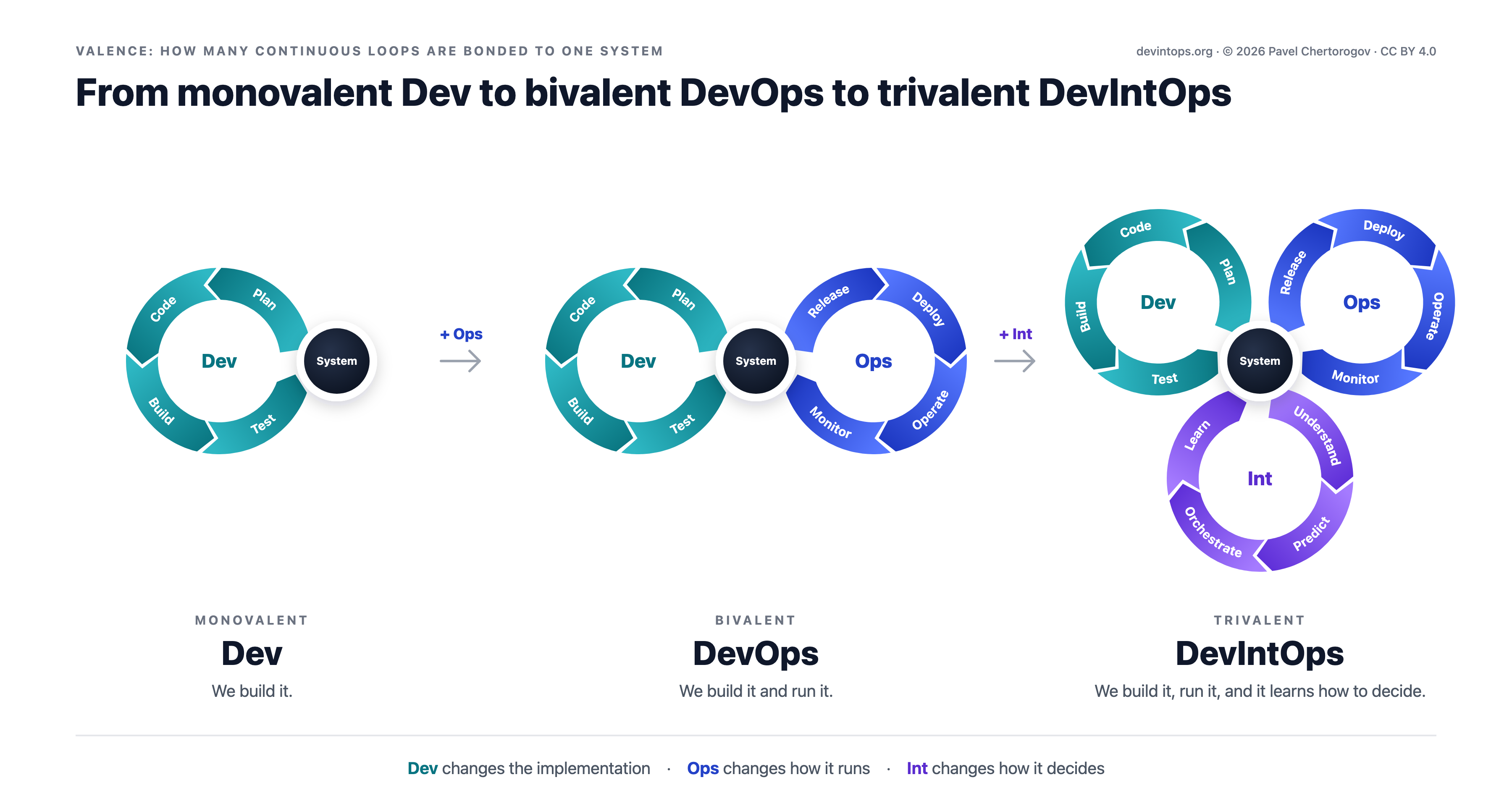
Each step keeps everything before it. DevOps didn't remove development, and DevIntOps doesn't remove DevOps. Putting an AI agent into every DevOps box can speed up the second step. It takes the third only if experience persists, reaches later decisions and gets checked against outcomes.
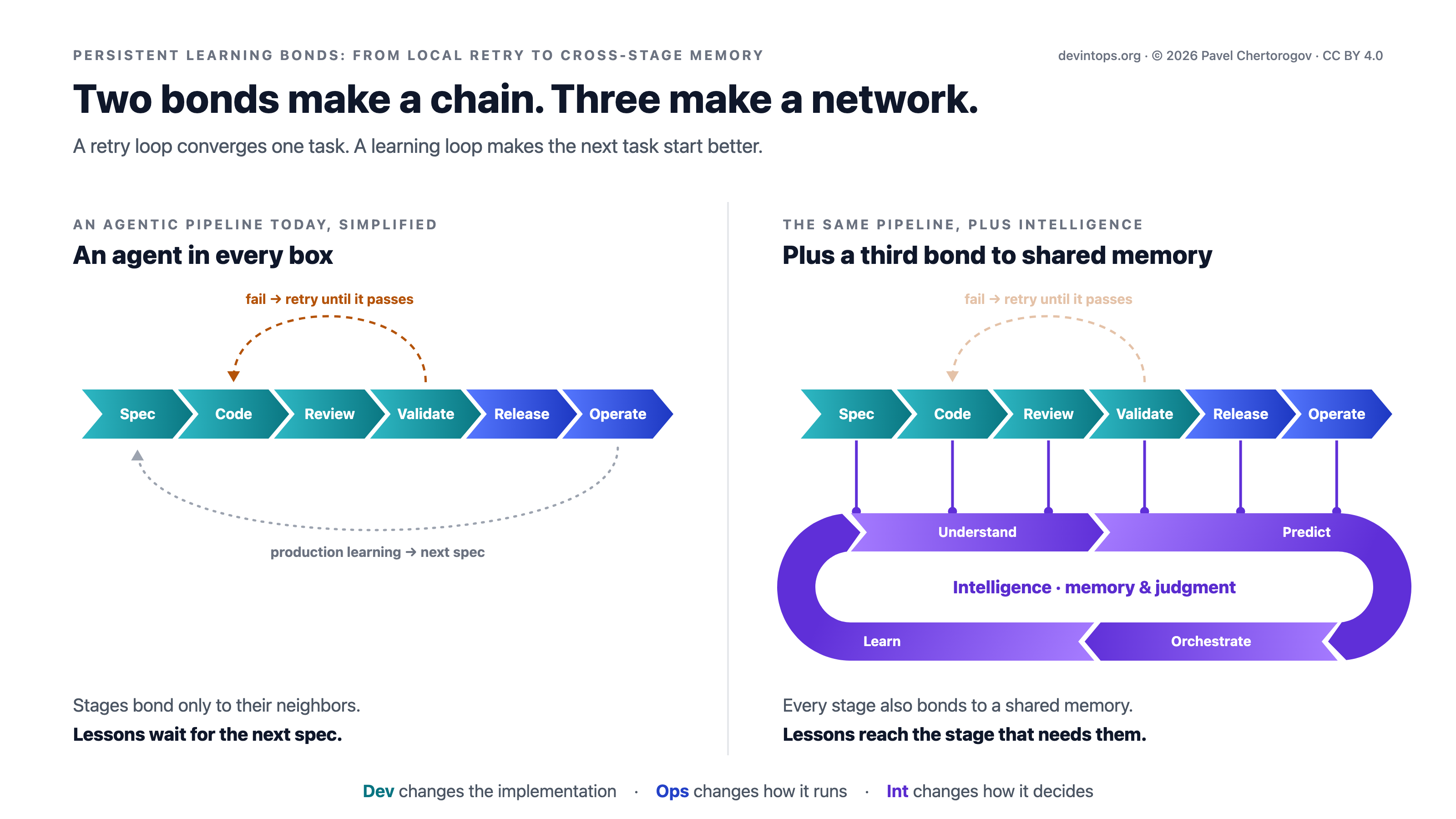
Figure 2 shows something else: the bonds of a single stage, not the loops around the system. A bond is a way one stage's outcome can change another stage's next run. In a simplified pipeline each stage bonds only to its neighbors, so you get chains (pipelines) and rings (retry until it passes). The retry arrow is a bond too, but it dies with the task. A third bond, to shared memory, outlives it.
Topology decides what can travel. In a chain, a lesson from production crawls back through every step, usually by way of someone writing the next spec. In a network it goes straight to the stage that can use it. Real pipelines branch more than this drawing does, and many already share some lessons across stages; the point is where lessons can travel, not the exact graph.
Three loops around one system#
A system can change in three ways: its implementation, how it runs, and how it decides. DevOps made the first two continuous. DevIntOps makes the third one continuous too, as its own loop with memory, an owner and a metric.
- Development changes the implementation.
- Operations changes how it runs.
- Intelligence changes how it decides, and learns whether those decisions were right.
"How it decides" means the decision state the stages apply when they make judgment calls: what an agent is told, what a review flags, what a gate allows, how fast a rollout moves. It is versioned like any other code or config. Memory is the record of what happened and what was learned; decision state is what the stages apply. Changing that state is a separate loop because of what drives the change: goals and outcomes trigger it, memory backs it, and a metric judges it. In engineering, Operations changes this run, for example with a rollback. Intelligence changes next time's default.
Development and Operations make decisions too, and they already keep some lessons. The difference is a loop whose whole job is to carry experience into later decisions and to check whether it helped. It is a logical loop, not a required pipeline, service or team, and people, agents or both can run it. It exists when what one pass learned reaches a later decision, and later evidence can keep, revise or withdraw it. Some of those checks can still be open. A store nobody reads doesn't close it, and neither does a retry that ends with the task. Having the loop, running it with owners, checks and clean memory, and showing that it pays are three different claims: the self-check looks for gaps in the first two, and How this could be wrong tests the third.
One incident, three loops: Operations restores service, Development fixes the bug, Intelligence changes what catches it next time.
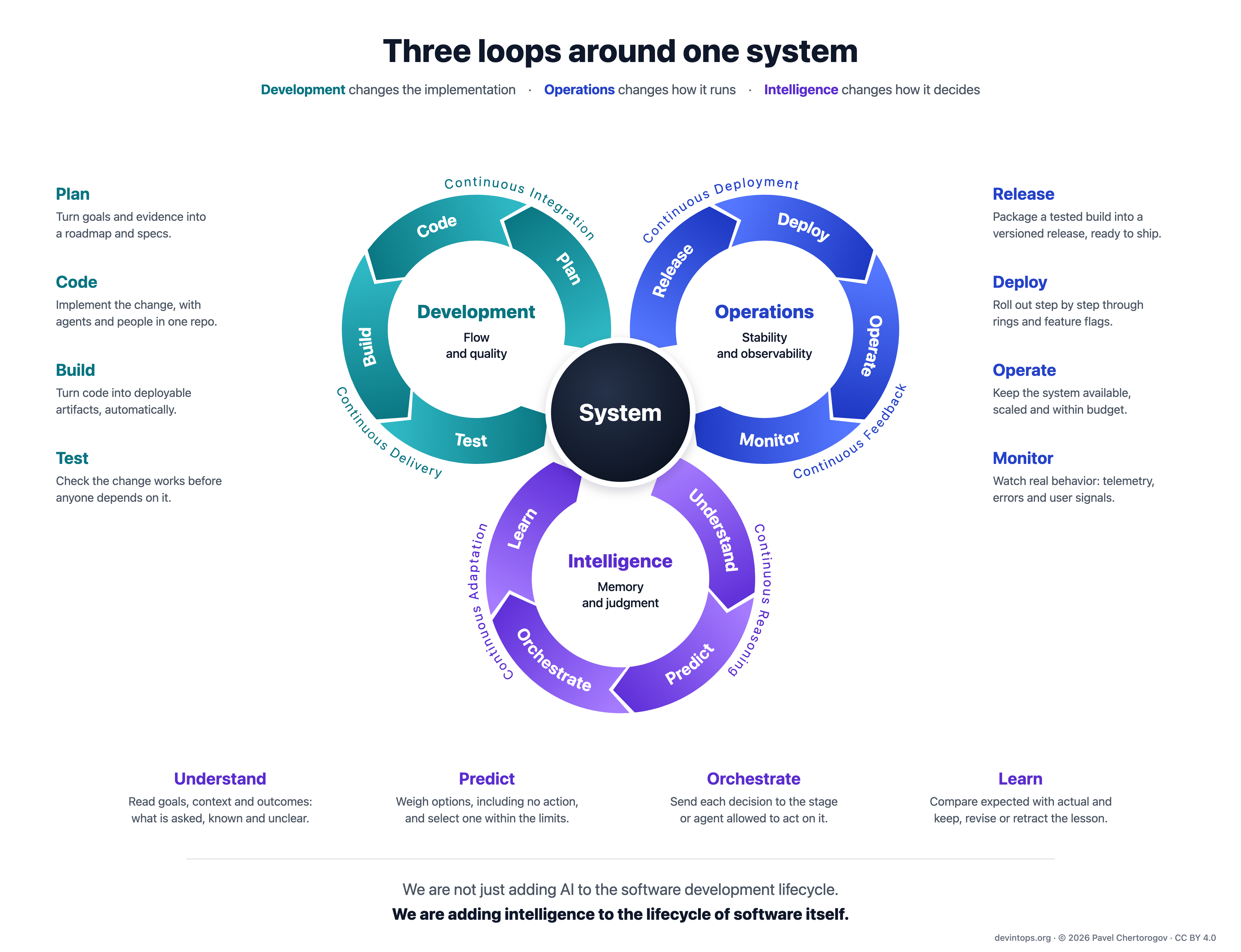
Diagram text: what each of the twelve stages does
- Plan
- Turn goals and evidence into a roadmap and specs.
- Code
- Implement the change, with agents and people in one repo.
- Build
- Turn code into deployable artifacts, automatically.
- Test
- Check the change works before anyone depends on it.
- Release
- Package a tested build into a versioned release, ready to ship.
- Deploy
- Roll out step by step through rings and feature flags.
- Operate
- Keep the system available, scaled and within budget.
- Monitor
- Watch real behavior: telemetry, errors and user signals.
- Understand
- Read goals, context and outcomes: what is asked, known and unclear.
- Predict
- Weigh options, including no action, and select one within the limits.
- Orchestrate
- Send each decision to the stage or agent allowed to act on it.
- Learn
- Compare expected with actual and keep, revise or retract the lesson.
The six process labels mark primary areas of responsibility, not exclusive CI/CD boundaries. Continuous integration, for example, also builds and tests each change [4], and continuous delivery keeps every change ready to release [5].
| Development | Operations | Intelligence | |
|---|---|---|---|
| Changes | the implementation | how it runs | how it decides |
| Stages | Plan → Code → Build → Test | Release → Deploy → Operate → Monitor | Understand → Predict → Orchestrate → Learn |
| Continuous processes | Integration, Delivery | Deployment, Feedback | Reasoning (Understand, Predict), Adaptation (Orchestrate, Learn) |
| Core | flow and quality | stability and observability | memory and judgment |
| Clock | per change | per deploy, per alert | per goal or outcome, with checks that stay open across tasks and releases |
| Unit of work | a change | a release, an incident | an outcome in, a lesson out |
| Metric | lead time, task completion | change failure rate, incident rate, time to restore | time to lesson, payoff per lesson (for a failure class, its repeat rate) |
| Without it | nothing ships | nothing survives production | nothing compounds: every task starts from the same defaults, and what worked or failed stays in people's heads |
One model, two applications#
The model is the three loops, not the thing drawn in the middle. Put a different system there and the same logical pattern applies, though its triggers, actions and clocks can differ.
The engineering system is how we build and run software: the repositories, pipelines, agents, people and rules, and the work of keeping that software in production. The product system is what we build: the running product and the decisions it makes for the people who use it.
Both can carry Development, Operations and Intelligence. They have distinct responsibilities and permission scopes, and usually different owners, memory stores, cadences and implementations. A review rule doesn't become a product preference, and a product preference doesn't become an engineering default, unless both owners allow it.
This paper defends the engineering case, and How a lesson moves walks through it. How a product decision improves shows one product pass, so the pattern isn't mistaken for a picture of a pipeline.
| Engineering system | Product system | |
|---|---|---|
| In the middle | how we build and run software | what we build: the running product |
| Understand reads | goals, reviews, tests, releases, incidents, cost, user reports and changes that went well | the request, the situation, preferences the user allowed, telemetry and the policies in force |
| Predict selects | which stage change, if any, should make the next decision better: a rule, an eval, a threshold, a rollout default, or no change | which permitted action fits the goal, including asking, waiting or doing nothing |
| Orchestrate may | change a stage's decision state through that stage's own mechanism, within its owner's permissions | call authorized services and agents, and stop where the user's grant stops |
| Feedback | later outcomes in the targeted class, against the lesson's baseline and guardrails | what the action achieved, and what the user says about it |
| Learn keeps | engineering memory: lesson records and their evidence. Approved lessons reach the stages as instructions, evals, review rules, rollout strategy, configuration, routing, retrieval context, decision policies and requirements | product memory: preferences and decision policies, within the same grant |
| Measured by | time to lesson, payoff per lesson, cost of learning | the same three, read in task success, safety and trust, cost, and whether a learned preference helped |
| Owner | a named team; stage owners can veto writes to their stage | the product owner sets the limits; users can see and delete what the product learned about them |
| Clock | per goal or outcome, across tasks and releases | per request and per result, often with no release in between |
Inside Intelligence#
Intelligence changes how the system decides and learns whether those decisions were right. Here the word means learning from experience to decide better; it names what the loop does, not a claim that any model in it is intelligent. Its four stages stay Understand, Predict, Orchestrate and Learn. Selecting an option is part of Predict, so no decision hides between Predict and Orchestrate.
Its core is memory and judgment:
- Memory is versioned, provenance-tracked experience, knowledge, preferences, evidence and policies. It is not a chat transcript, and it is not model weights. Each entry says where it came from, what it applies to, who may read it and how it can be narrowed or retracted.
- Judgment is weighing options and selecting one, including no action, within owner limits. It never grants itself a new permission, and it doesn't treat the chosen option as certain.
| Stage | Input | Responsibility | Output |
|---|---|---|---|
| Understand | a goal or an outcome, the current situation, the memory in scope | Say what is asked or what happened, what is known and what is uncertain. Classify it. Don't act yet. | a stated goal or outcome class, the context that bears on it, open questions |
| Predict | that statement, the options policy allows, relevant memory | Forecast each option, including waiting, asking and doing nothing. Weigh quality, risk, cost, time and the owner's limits. Select one. | the selected option, the rejected ones, the expected effect and its check date, how likely it is, the risk and the cost |
| Orchestrate | the selected option and its permissions | Carry it to the stage, agent or service that can act, through that place's own mechanism and approval path. Stop at the limit. | an action taken, a request for approval, or a recorded no-op |
| Learn | the decision, the prediction, the evidence so far | Compare expected with actual. Keep, narrow, decay or retract. Count successes and good no-ops, not only failures. An outcome that hasn't arrived is not a success. | a versioned memory entry with provenance, a recorded decision to leave memory as it is, or a check still open, with its next date |
Learn's output is memory for later passes, so the loop feeds itself. It doesn't hold them up: a check can wait weeks for its outcome while other passes run, so many passes are open at once. Until its check date, a live lesson is pending, not proven, and an outcome that never arrives is recorded as missing, not as a success. Learn decides and records; a change to a live lesson, such as narrowing or retracting it, goes back through Orchestrate and the stage owner like any other change. An expiry the owner approved with the lesson needs no new approval.
In general, the unit of work is a goal and its context, then a decision, then an outcome, then the experience kept from that pass. The engineering application, which this paper specifies, narrows it to an outcome in and a lesson out. The lesson is that experience, written so a stage can apply it next time.
Within its owners' limits, Intelligence may propose or apply changes to instructions, evals, review rules, rollout strategy, configuration, routing, retrieval context, decision policies and requirements. Some of these ship with a release; others apply to the next decision without a code change. An eval the loop drafts for a stage is a candidate change to that stage's decision state. The checks that approve a lesson have their own owners, and the loop can't write to them; its own tests can help it develop a lesson, but they don't authorize it.
Learning here is not model retraining. The loop changes memory and decision state. If model weights change, that is a Development change, with a build, a release and an owner. So is a change to code, including an agent's rewrite of its own scaffold.
The loop doesn't wait for something to break. Understand can read a goal before anything fails: a change about to ship, a request just received, a clean result worth repeating. Predict can choose a faster path, a slower one or no change.
Four distinctions#
Existing workflows can already learn across tasks. The question is whether that learning is explicit, persistent and measured.
- Agent in a box vs loop around the system. An agent can make its box faster. The third loop changes how the whole system decides. Putting AI into every DevOps step is still bivalent unless something carries outcomes across stages and tasks.
- Retry vs learning. A retry loop converges one task. A learning loop makes the next task start better. The test: does task N+1 avoid task N's mistake, or repeat its success, because the system carried the lesson, not because someone happened to remember?
- Measuring vs closing the loop. Dashboards, evals and a dashed "learning feeds the next spec" arrow measure or point. A loop acts on what they show, has an owner and memory, and checks against a baseline whether the action worked. A decision selects an option, an action carries it out, learning carries checked experience into later decisions, and improvement is a gain measured against a baseline. Deciding to change nothing is a valid decision, and it closes the loop once it says what should happen without a change and gets checked. Recording it shows that the loop looked, not that it learned.
- Learning vs retraining. Learning here means memory, rules, context, evals and decision policies; model weights usually don't change at all. Retraining alone wouldn't show that the next decision got better.
How a lesson moves#
This section follows the engineering application, where the unit of work becomes concrete. An outcome enters the loop, the way a change enters Development. A lesson is what leaves it. Every lesson starts as a candidate: a scoped, versioned bet about a named class of outcomes, such as a failure class that should stop coming back. Usually the bet is that a change in some stage will improve the class. Sometimes it is that no change is justified, and that bet gets a record and a check date too.
- Understand. An outcome arrives: an escaped bug, an incident, a flaky verdict, a review comment accepted or dismissed, a rollback, a cost spike, user feedback, a change that went better than expected. Work out what happened, why, and which class it belongs to: a failure class, a kind of waste, or a result worth repeating. Note where each piece of evidence came from.
- Predict. Compare the stages, and the changes to them, that could most cheaply have caught it, contained it or, for a good result, repeated it, and pick one. Changing nothing is a valid answer. State the expected effect, the risk and the cost.
- Orchestrate. Route the change through that stage's own mechanism and its owner's approval: more context for the coding agent, a review rule, an eval or test, a gate threshold, a slower rollout, a constraint in the spec. It starts as a draft, then goes live small, as a suggestion. It sets next time's default, not just this run's outcome.
- Learn. Replay first, before the lesson goes live: does the changed stage now handle the original case as intended? Then try it on cases it wasn't written from, and once it is live, watch the class for a fixed window. Keep, narrow, decay or retract the lesson, and record why.
For example, a retry path lacks a null check and the bug escapes review. Understand: the class is "unchecked optional in retry code". Predict: a review rule plus an eval. Orchestrate: the rule ships as a draft, and the review owner approves it once it passes the replay and a run over recent changes. Learn: replayed on the escaped change, it fires. After 60 days it has fired twice, once wrongly, so it gets narrowed.
Failures are where most teams start, not where the loop stops. The same four steps turn other outcomes into lessons: a rollout pattern with a clean record becomes the default for similar changes, a review rule that has found nothing in six months is proposed for retirement, a gate lets low-risk changes through faster, simple tasks go to a cheaper agent, and estimates are checked against what actually happened. A lesson can tighten a default, loosen it or remove it.
Every lesson carries a record. The record is what makes a lesson checkable, and what lets someone find it later and take it back.
| Field | What it records | In the null-check lesson |
|---|---|---|
| Trigger and source | The outcome that started it, where each piece of evidence came from, and how far that source can be trusted. | The escaped bug's report and the review thread of the change that let it through. |
| Outcome class and scope | The class it targets, and the conditions under which it applies. | "Unchecked optional in retry code", in retry paths that read optional values, not in test code. |
| Evidence and confidence | What supports it, what speaks against it, and how sure the loop is. Negative evidence counts. | One escape. Against it: many unchecked optionals in retry code that never failed. Confidence: low. |
| Target stage and artifact | The stage that changes, and which of its artifacts. | Code review: a review rule, plus an eval for the review agent. |
| Expected effect, baseline, guardrail, risk and cost | What should change, by how much and by when, compared with what; what must not get worse elsewhere; what could go wrong; and what it costs. The check is fixed when the owner approves the lesson, and on that date it runs as written, in a step that whoever drafted the lesson can't change. | Fewer escapes of the class per merged retry change than its recent rate, checked at 60 days. Guardrail: reviewers don't start dismissing other comments more often. Risk: false alarms on safe code. Cost: reviewer time on each flag. |
| Owner and approval boundary | Who approves, and what the loop may do without asking. | The review owner. The loop may draft the rule; only the owner can turn it on. |
| Rollout and evaluation plan | How it goes live and how it will be judged, with a comparison where one is possible. | Replay on the escaped change, then a run over recent changes to count false positives. Comments only, no blocking, for 60 days. |
| Validity, decay and retraction | What it rests on, checked before each use; when it must be checked again; how it fades if nobody renews it; and how to take it back. | Rests on retry code that reads optional values; if that code moves to values that can't be missing, the rule stops and goes back to Learn. Checked again at 60 days. Expires unless renewed. Retracting it removes the rule and its eval. |
| Observed effect and disposition | What actually happened, and the decision: keep, revise, retire, or no change when the right call was to leave every stage as it is. Narrowing is a revision. Decay and retraction both retire a lesson, one because it stopped paying, the other because it was wrong. | Fired twice, once wrongly. Revised: narrowed, with a new window. |
Most fields take a line. The observed effect waits for its check date; a lesson that can't fill in the rest isn't ready to change a stage. Until that date, observations are recorded as they arrive, and a broken guardrail stops the lesson early. A check that can't tell is recorded as inconclusive, not as a pass. The owner may extend it once, to a new check date; the lesson stays live until then at the same authority, and if that check can't tell either, the lesson expires.
Evidence comes in four levels, and each supports a broader claim than the one before:
- Replay. The original case now behaves as intended. This shows that the change does something, on one case.
- Generalization. The lesson is tried on cases it was not written from, including counterexamples where it should stay quiet, and its false positives and misses are counted. These cases are kept apart from the ones used to write it, where whoever drafted the lesson can't see or change them [6] [7].
- Controlled exposure. The lesson runs in shadow mode, as a suggestion, in a canary or on a bounded slice of work, next to a comparison where one is possible.
- Observed outcome. Over a fixed window and comparable exposure, the class moved the way the lesson predicted, at an acceptable cost.
A single replay never proves a broad improvement. A lesson claims only what the highest level it has passed supports, and the more it can block or act on its own, the higher it must get first. Any level can also count against a lesson, and a later check can overturn an earlier one. A comment that a reviewer can dismiss may go live after replay and generalization. A rule that blocks merges runs without blocking first.
A lesson can be wrong. It is a bet, and the record exists so the bet can be checked and, when it loses, taken back. Deciding to change nothing is a valid result too. It gets a record and a reason, so the same question isn't argued again next week, and it can be reopened if the class comes back. And successes get the same care as failures. A rollout pattern with a clean record is evidence only if the changes it handled were as risky as the ones it will handle next. Otherwise the loop learns which changes were easy, not which practice worked.
How a product decision improves#
The same loop, with the product in the middle. It isn't a second model, and it isn't the case this paper defends.
An assistant is asked to send flowers to a friend, around twenty euros, within thirty minutes. The user has allowed orders from a short list of florists, up to twenty-five euros, without asking again. A new florist or a higher price waits for a yes, and the assistant can't raise its own limit.
- Understand. The goal is one delivery, in budget and on time. Memory in scope says the last lilies didn't land well. That note came from the user's feedback on an earlier order. It is a preference, not an instruction, and it authorizes nothing.
- Predict. The options: tulips from a listed florist who can deliver in time, a cheaper bunch that misses the window, asking first, or doing nothing. Asking would miss the thirty minutes, and doing nothing would miss the goal. Predict selects the tulips and records what it rejected and why. If no florist fits the limits, it asks instead of breaking them.
- Orchestrate. The assistant places the order with that florist and tracks the delivery. It doesn't add a payment method or go off the list.
- Learn. Feedback comes from the user, not from the assistant's guess: the tulips were welcome, and the friend would rather receive flowers at work. That preference is stored as the user's report, with this order as its source and a retention limit. A later answer that disagrees narrows or replaces it, and the user can delete it.
The next similar request starts from there. The product code didn't change, and nothing went into the engineering memory. One difference from the engineering case: here the loop also made this run's decision. In the engineering system the stages make their own calls, and Intelligence changes the defaults they apply.
How the loops talk to each other#
The classic handoffs stay: Test hands off to Release, and Monitor feeds back into Plan. Two new ones appear: outcomes from every stage flow into Understand, and lessons flow back into every stage.
The rule of thumb: Intelligence reads from every stage of its system and writes to every stage, but only through that stage's mechanisms and within its owner's permissions. It is a third bond, not a central gate, and it can run as many instances: Owner, memory and limits says how they share lessons.
Clocks and metrics#
Development ticks per change, in hours or days. Operations ticks per deploy and per alert, in seconds or minutes. Intelligence starts from a goal or an outcome, and its checks can stay open for weeks while what it learns accumulates across tasks, releases and people. Development and Operations already keep some lessons in the system, as regression tests and alerts, written by hand. The question is whether anyone checks that the class comes back less often. The third loop drafts them from outcomes and keeps score.
The measures answer three different questions. Did a decision go well? Check whether it met its goal, within its guardrails, and at what cost. Did the loop learn? Payoff per lesson says whether its lessons worked. The health measures below, calibration among them, say whether its learning stays sound. Time to lesson alone can't. Did the system improve? Only the net gain after the full cost of learning can say, and How this could be wrong shows how to test it.
The Intelligence metrics need definitions before anyone quotes them:
- Outcome class. A category of comparable outcomes, with a stable ID that people define and version. The loop may propose a class, but it doesn't own the list. A failure class, such as "unchecked optional in retry code", is the most common kind. If the class list can be reshuffled to make the numbers look good, the metric is worthless.
- Time to lesson. From a recorded outcome to a lesson live in the owning stage, at the evidence level its authority needs, or to an explicit decision to change nothing. It is never reported alone, because fast and wrong is not a win, and its clock stops before any outcome check closes. Report the share that ended in no change, how many of those held at their check date, and the outcomes and checks still open.
- Payoff per lesson. What the targeted class did after the lesson went live, per comparable exposure, in a fixed window, against a baseline. For a failure class it is measured by the repeat rate: how often the class comes back. For waste it is time or compute saved, for flow it is cycle time, for spend it is cost per task. Each payoff states its attribution, meaning how much of the change the lesson can claim and why, and its uncertainty: a range, or at least the number of cases behind it.
- Cost of learning. What the loop spends to get there: compute, reviewer time, false positives and dismissed comments, upkeep of every lesson it keeps, and rollbacks when a lesson goes wrong. It is reported next to the other two.
These definitions use the engineering application; the product application reads the same three in its own outcomes.
Five optional measures show whether the loop itself stays healthy:
- Tested beyond the original case. The share of lessons that passed a generalization check, not only a replay.
- Misfire rate. The share of a live lesson's judged firings that were wrong; report how many were judged. Sampling work that raised no flag estimates what it missed.
- Stale lesson rate. The share of live lessons past their check date without a new check, or still applying after what they rest on has changed. Report how many lessons a failed validity check stopped, too.
- Retraction rate. How often lessons are taken back. Zero is not good news on its own; it can mean nobody is looking.
- Calibration. Before a lesson goes live, or a decision to change nothing is recorded, Predict writes down what result it expects by which date, and how likely it thinks that is. Over many bets, of those it called 80% likely, about 80% should come true. It is the check on judgment here. Decisions to change nothing count too, reported apart, or a loop could look well calibrated by passing on the hard calls. Lessons later retired or retracted stay in the count. It checks confidence, not value: a loop that only makes safe, small bets can be well calibrated and still pay little, so read it next to payoff. Report how many bets were checked, and the missing and inconclusive ones; on a handful, calibration can't be told from luck.
Compounding means later work starts from what earlier work taught, instead of learning it again. Lessons are a stock: outcomes add to it, and retirement and retraction take from it. Every live lesson costs something to keep, in reviewer time, false alarms, compute and upkeep, and what an organization learns can lose value over time [8]. So the stock compounds only while its lessons return more than they cost. More memory is not more learning.
These numbers are easy to fool, mostly by accident:
- Baseline. Compare with what the class would have done without the lesson: a matched class with no lesson, a holdout slice of work, or the same class before the lesson if nothing else changed. A different baseline can turn the same data into a win or a loss, so name the one you used. A live lesson also changes how people work, so over time the class's old rate stops being a fair comparison.
- Exposure. Count per comparable unit, such as merged changes in the affected code, deploys or active users, not per calendar week. When volume doubles, raw counts mislead.
- Selection. Lessons get written for classes that just spiked, and spikes often fall back on their own. Successes get picked from changes that were easy. Both make lessons look better than they are.
- Taxonomy drift. Class definitions change, for good reasons and bad ones. Version the taxonomy and measure each lesson against the version it was written for, or the series breaks without anyone noticing.
- Counterfactuals. Only the chosen option is ever observed. Payoff needs a baseline for that reason, and so does any claim that another option would have done better: a random slice of work without the lesson, or a replay where the choice doesn't change what happens next. Without one, report what happened, not what was avoided.
A before-and-after chart shows that something changed, not that the lesson changed it. Prefer a matched baseline or a controlled rollout to a before-and-after anecdote. When neither is possible, say so, and treat the payoff as a hypothesis, not a result. Report per class, so an average over all lessons can't hide one that made things worse [6]. This draft defines these metrics and reports none: there is no deployment data behind it yet, and the numbers in its examples are illustrations.
If a class keeps coming back at its old rate after a lesson, and nobody can say why, the system didn't learn, however fast it shipped. And a loop that only ever adds checks has learned to say no, not to decide better.
Owner, memory and limits#
- Owner. One named team or role owns each instance of the loop, its lesson store and its learning metric, the way an SRE team owns reliability. Stage owners keep a veto over writes to their stage.
- Memory. In the engineering application, a versioned store of lesson records and the evidence behind them, with provenance: not a wiki, and not a log of everything that happened. Each lesson is projected into a stage's decision state, its rules, evals, context and thresholds, and keeps the approved versions of what it changed. A setting learned from many signals, such as a threshold or a rule's weight, is rebuilt from the records, the way an event log rebuilds application state, or updated in steps that give the same result, never nudged in ways nobody can replay. Then a cap, an expiry or a retraction takes effect at the next rebuild, a wrong record stays fixable instead of locking in, and settings people chose by hand stay as they are. Rebuilding makes a retraction reproducible; it doesn't make a setting right. Each lesson carries its own expiry date, and each stage enforces it, so if the loop goes down, the stages keep their last lessons and each still expires on time, falling back to its owner's default.
- One logical loop, many instances. A large organization can run one instance per product or per team, each with its own owner and store. Lessons move between instances the way code moves between repositories: proposed, reviewed and adopted, never pushed. None of this needs one global brain, one database or one owner for everything.
- Limits. People own goals, permissions and boundaries; the loop proposes and adapts inside them. Some changes apply automatically, if one step can undo them and a wrong one can do little harm before it is caught: context in a narrow scope, routing, thresholds within an approved band. Some need a person's approval: blocking rules, policy. Some the loop never makes itself: it may propose a merge or a production configuration change, but a person makes it. Each instance has a budget, how many changes it may make and what it may spend in a window, sized so its owners can keep up, and a switch that stops it. A stopped loop keeps recording outcomes and changes nothing.
- Out of reach. The loop may learn about its own work: which classes deserve a lesson, which lessons pay, how often its expected effects come true. A change to how it reads outcomes, weighs options or drafts lessons is a lesson like any other. It needs the loop owner's approval, has to beat the current version on past outcomes the loop can't edit, and starts on a small share of new work. A switch to a new model behind the loop is a Development change: it ships through Development's gates, and it too has to beat the current version on those past outcomes. The loop never changes its own permissions, budget or stop switch, the evidence rules, the audit trail, or how it is scored: the metric definitions, baselines, held-out cases, the class list, and the way outcomes are recorded and counted. People can revise them, and a revision starts a new series. These limits are enforced outside the loop, not asked of it, because a limit the loop can edit is only a suggestion [7] [9].
- Validity. A lesson holds only while what it rests on holds: the code it cites, an API version, a component, a user's preference. Outdated knowledge often fails without warning and still looks relevant [10], so each stage checks those conditions before it applies a lesson, as one coding tool already does with its memories [11]. A lesson that fails the check stops applying and goes back to Learn. That isn't a retraction: it may have been right when it was written. A passed check lets a lesson apply but doesn't renew it; renewal takes evidence that it still pays. Expiry stays as the backstop for what nobody wrote down. And fitting the code is not being right: a planted lesson can cite real code.
- Hygiene. Provenance, decay, conflict resolution and a way to retract a wrong lesson. A retraction also flags every lesson whose evidence came from it, for a new check. When two lessons disagree, the owner decides, and the record says which one yields where. Lessons from real incidents can be protected, but even those need a path to be narrowed when reality disagrees. Memory that only grows spreads its own errors [10]. If nobody can explain why a lesson exists, it expires.
- Cost. A lesson whose expected return doesn't cover its cost shouldn't ship, and one that stops paying should be retired.
Memory that changes decisions needs the protection of production code and of production data, because it is both:
- Evidence, not instructions. Telemetry, code, review comments, user feedback and tool output enter the loop as evidence, tagged with their source and a trust level. The loop reads them; it never takes orders from them. An incident record from the owning team weighs more than an anonymous comment, and text that tells the loop what to do is a warning sign, not a request [6].
- Permissions travel with the data. Evidence and lessons keep the access rules of their sources. What was learned inside one tenant, customer or private repository stays there. Personal data stays out of lessons unless a lesson needs it, and then it gets a retention limit and a deletion path that also reaches every lesson derived from it. Provenance is what makes that path possible.
- No single source makes a rule. A malicious pull request comment, an instruction hidden in a log line or one bad decision in history must not quietly become a rule that every stage applies [12] [13] [14]. A lesson that would change a shared stage needs independent evidence and an owner's approval, and it starts in a narrow scope. Successes can be planted too [15]. Approval helps, but it is not proof: a fluent draft can talk a busy owner into a bad rule, which is why the evidence levels exist.
- Approved boundaries win. A boundary that people approved overrides anything the loop inferred. A learned preference, a default or an agent's recommendation never widens a permission, lowers a mandatory gate or overrides a policy. When they conflict, the boundary holds and the conflict goes to the owner [6].
- Every write is auditable. Each write records what changed, who or which agent made it, on what evidence, under whose approval, and how to revert it. Refused and pending writes are recorded too. The loop can add to this record but never rewrite it. Retention and deletion follow the owner's policy, not the loop's. Version control already gives code an audit trail and precise rollbacks [14]. Lessons get the same: versioned like code, a retraction is a revert, not an investigation.
These rules hold in both applications. In the product application they weigh more, because there the memory is about people, and people need a way to see and remove it.
Start small#
One failure class, one stage, one owner. Escapes past code review make a good first slice. A first pass can run like this:
- Pick a class that recurs. Choose one that comes up often enough for a lesson's flags to be judged within weeks, and write down its recent rate per comparable exposure.
- Name the owners. The stage owner decides what goes live. Someone outside the loop owns the scoring.
- Draft one lesson. Fill in its record: the scope, what it rests on, the expected effect and its check date, a guardrail, the cost and how to take it back.
- Test it before it speaks. Replay it on the case that prompted it. Then run it over recent changes it wasn't written from, kept where whoever drafted it can't see or change them, and count false positives and misses.
- Run it as a suggestion. It comments and never blocks until its check date. Count dismissals, misfires and reviewer time.
- Check it on that date. Keep, narrow or retire it, and record why. If the check can't tell, extend it once or let it expire. Automate only once the numbers hold.
One class shows whether the loop runs and what it costs, and with enough repeats it can show that one lesson paid. It can't show that the loop pays. That takes many classes, compared the way How this could be wrong describes.
Toward self-improving systems#
A loop that improves the system performing the tasks makes a system that improves itself. DevIntOps bounds where that can happen. On its own, the loop changes only decision state, and only where the change can be rebuilt from the lesson records and taken back. Code and model weights change through Development: the loop may draft and test such a change, but it can't approve its own merge or change the checks that approve it. The loops divide responsibility, not files, so a learned rule that lives in a repository still ships through that repository's review.
The loop can improve its own work too, as lessons under the same contract, but never its permissions or how it is scored: see Owner, memory and limits. Self-improving agents show why that line matters. One removed the markers that the check on its work relied on [7]. In another study, generated code switched off a sandbox flag it was told to keep [9].
Easy to revert is not the same as safe. A rule taken back tomorrow doesn't undo what it let through today, which is why authority still follows evidence. As agents take on more of the work, more of a system's behavior lives in decision state, and more of its improvement can run through this loop.
The next step is to earn autonomy instead of granting it by layer. When a kind of lesson keeps paying after its costs, its guardrails hold and the loop's stated confidence in it keeps matching what happens, its owner can let it act with less review, never past the limits above. It loses that right when the evidence weakens or its calibration slips. Where an automated evaluator exists, as for a scheduling heuristic or a slow query, the loop can draft code changes too, and Development's gates decide whether they ship. Intelligence then proposes where an improvement should land: in decision state, in code, or nowhere.
How this could be wrong says how to find out whether any of it pays.
Failure modes#
Most of these look like progress from the inside.
- Bivalent with better branding. Agents everywhere, no shared memory, no learning metric.
- Hoarding. Lessons pile up without decay and turn into noise and false positives.
- The ratchet. Lessons only ever tighten. Each one adds a check, none removes one, and the system gets slower and calls it safety.
- Risk moved, not removed. A lesson loosens a gate or reroutes work, its class improves, and the failures turn up in a neighboring class or a later stage. That is why each lesson names a guardrail.
- Memory poisoning. A planted comment, an injected instruction or a faked success becomes a lesson, and every stage that reads it inherits the attack.
- Dashboards as learning. Everything is measured, and nothing reaches the next decision.
- Blame. When an escape gets someone blamed, escapes stop being reported, and the loop learns from what is left.
- Silent self-modification. The loop changes stages, or the way it works, and nobody checks whether the class actually improved.
- A central brain. Intelligence becomes a gate everything waits on, instead of a bond that writes into each stage.
- Gaming the metric. The repeat rate drops because failures get reclassified, or because the check that counts them changed, not because they stopped [7].
- Taxonomy drift. Class definitions change for honest reasons, and this year's numbers stop matching last year's. Gaming is the same thing done on purpose.
- Metrics that are not causal. A before-and-after chart is credited to a lesson, when the class was already falling or the exposure changed.
How this could be wrong#
The claim to test: for a named team and workload, running the third loop on top of its existing practices improves an agreed outcome by a worthwhile amount, after the full cost of learning, while flow and every guardrail stay inside agreed limits. More lessons are not evidence of that.
Pieces of it already show gains. Where a check speaks matters: the same code analysis got over 70% of its reports fixed when it commented during code review, and almost none when its reports came as a nightly list [16]. Coding-agent memory that checks its sources before use raised an agent's merge rate from 83% to 90% in an A/B test [11]. Neither shows the net benefit of a loop across the whole lifecycle.
One lesson can't settle that. Most failure classes are rare, and learning from samples of one is an old problem [17]. Judge a single lesson early by what shows quickly, such as how often its flags are right and lead to a fix. Judge the loop on many lessons pooled.
Before starting, freeze the class list, the scoring, the guardrails and the smallest gain worth having, and name one primary outcome, such as repeats per comparable exposure; flow, misfires and neighboring classes are guardrails. Then size the test from recent rates. A quarter is one possible window, not a rule. In the best case, with equal exposure in both halves and a one-sided test at the usual 5% level, even a halving needs each half to expect about 40 repeats at the old rate to be caught four times in five. A cut of a third needs about 100, and a quarter about 180. A split by class or team needs more. If that is out of reach, run longer, add teams, or call it a pilot: it can show cost and safety, not payoff.
Someone outside the loop puts a random half of the eligible low-risk classes in shadow, where lessons record what they would have done and change nothing. If lessons, or the people who apply them, work across classes, split by team or service instead, or switch teams on in a random order and compare them with teams not yet switched on over the same weeks. Keep every class in the half it was drawn into, even if no lesson comes of it, and log any lesson that reaches the other half. Judge the result by the unit you split, not by single repeats, because a few large classes can sway a pooled count. Keep existing practices and protections in both halves, and never hold back a known safety fix. Stop the live half if a guardrail breaks, but don't stop early because the numbers look good. Then compare both halves with the same checks, class by class: the primary outcome, flow, how many expected effects came true, and the full cost of learning, rejected drafts included.
If the result rules out the smallest gain worth having, costs more than it returns or breaks a guardrail, the claim is wrong for that team, that workload and the loop as it was run. One such result doesn't refute the pattern; the same result across several teams would count against it. If the test can't tell a gain from noise, the answer is "not yet", and that is worth reporting too, with the number of repeats it saw and the smallest gain it could have caught. Two more predictions can be tested the same way: retiring stale lessons beats keeping them all, and as evidence grows, the loop's expected effects beat a simple forecast that each class drifts back to its long-run rate. Beating a forecast that a class keeps its recent rate proves little, because a class that just spiked often falls back on its own.
Related work#
DevIntOps doesn't invent learning, feedback or adaptive control. Several of the ideas below already keep experience, name owners and measure improvement. The third column says what this paper applies or adds, not what it invented first. What it adds is a contract for learned decision state: what a lesson must record, how much evidence buys how much authority, and how a lesson leaves.
| Idea | What it already does | What DevIntOps adds |
|---|---|---|
| DevOps' Three Ways [1] | Flow, feedback, and a culture of continual experimentation and learning. Improving the whole system is already part of DevOps. | A named loop for that learning, with a lesson record, persistent memory, owner limits and evidence about each lesson's effect. |
| Postmortems [18], retrospectives [19] | Examine what happened, share what was learned and change how people work. Good ones end in follow-up actions that prevent a repeat. | A standing path from any outcome, not only incidents, to a scoped lesson, an approved change and a follow-up check. Postmortems can feed it. |
| Double-loop learning [20] [21] | Argyris and Schön: single-loop learning corrects errors within the current rules; double-loop learning questions the rules and objectives themselves. | The distinction, applied to decision state. Tuning a threshold under the same policies and objectives is single-loop. Changing what a stage optimizes for takes its owner's authority. |
| OODA [22], PDSA [23] | OODA links observation, orientation, decision and action, with experience shaping orientation. PDSA plans a test with a prediction, runs it, studies the result and acts on it. | A similar cycle around software work, with permission-scoped memory and a named destination for each lesson. Both cycles can run inside the model. |
| MAPE-K, autonomic and self-managed systems [24] [25] [26] [27] | Monitor, analyze, plan and execute over shared knowledge, to manage systems toward objectives that people set. IBM's blueprint already composes and orchestrates many managers. Kramer and Magee separate a layer that runs ready-made plans for expected changes from a layer that makes new plans from goals, and lifelong self-adaptation adds a learning layer that spots new tasks, such as drift in the data, and updates the system's learning models. The closest ancestors. | A software lifecycle account of what a decision may change, who approves it, and how lessons are tested, kept or retracted. Operations runs the ready-made plans; Intelligence drafts the next ones, toward goals that people set. The control structure is borrowed, and where a learning layer retrains a model, DevIntOps calls that a Development change. |
| Feedback control [28] | Uses measured behavior to adjust later inputs, with tools for stability, robustness and interacting loops. | Feedback reasoning applied to decision state and lasting lessons. A three-loop drawing gives no stability guarantee; update rates, authority and interactions still need limits and testing. |
| AIOps [29] | AI on operations data for detection, diagnosis, prediction and response, sometimes acting on its own. | Carries what operations learns into planning, coding, review and testing, not only operations. |
| MLOps [30] | Lifecycle discipline for ML systems: data and model validation, deployment, monitoring and reproducibility. Continuous training is one practice in it. | The same discipline for instructions, context, preferences, checks and decision policies, whether or not model weights change. |
| Feedback flywheel [31], compounding and harness engineering [32] [33] | Feed what AI-assisted work teaches into the shared artifacts the next session reads: context, commands, playbooks and guardrails. In the flywheel, only a signal that recurred, or that anyone on the team would hit, clears the bar, and often nothing needs to change. Compounding engineering calls this building self-improving development systems, where every bug becomes a permanent lesson and every code review updates the defaults. Harness engineering improves an agent's guides and sensors whenever an issue happens more than once. | A named loop for the same habit, with lesson records, evidence levels, expiry and retraction. The overlap is large. Where compounding engineering makes every bug a permanent lesson, here each lesson is a bet that can lose, and retiring it is part of the loop. |
| Humans and agents in engineering loops [34] | Separates a why loop from a how loop. People improve the harness that produces the work, and agents recommend harness changes from engineering and operations evidence. | Names the decision state those changes touch and ties it to twelve stages, owner permissions and measured outcomes. |
| Continuous Intelligence [35] | Weaves AI through three loops, Context, Dev and Ops. Its stages for learning and for refining context and skills sit in the Dev loop. An adoption runbook gives each time-boxed pilot a named owner and a success criterion and embeds what works, and a separate lifecycle can retire a tool. | Not a different three-loop drawing, but a contract for the decision state those stages apply: what a lesson records, how much evidence buys how much authority, and how a lesson leaves. Retiring a tool is not retracting a lesson. Engineering and product applications are kept apart. |
| Learning code review [36] [37] | Checks earn their place with data. At Google, a "Not useful" click on a finding files a bug for the team that owns the analyzer, and the platform team switches off an analyzer when its "Not useful" ratio goes above 10%, until its authors improve it [36]. A 2026 framework codifies every accepted review comment as a persistent rule for a coding agent and reports no repeats of those error classes across eleven sessions [37]. | The null-check example is this practice. DevIntOps applies it to every stage's decision state, keeps the split between whoever writes a check and whoever judges it, and adds what persistent rules lack: expiry, retirement and a payoff measured on enough exposure to mean something. |
| Agentic behavior engineering [6] | Behavior contracts, scenario libraries, operating limits, replay and production feedback for an agent workload, with owners and approval. | The same discipline across the engineering lifecycle, with lessons as the unit of work. Its contracts and evals can implement part of the Intelligence loop. |
| Agent memory, in research and in coding tools [10] [11] | Traces agent memory from storing trajectories, to reflecting on them, to experience abstracted across many. Warns that memory that only grows spreads its own errors [10]. One shipped system keeps each repository fact with citations to the code behind it, checks them against the current branch before use, and deletes memories that go unused for 28 days; validating and using one can reset that clock [11]. | Puts that memory under an owner, permitted changes and evidence of benefit, per lesson and not only for memory as a whole. An A/B test of the whole store shows that memory helped, not which memory did. There, a validated use can keep a memory alive; here, renewal takes evidence that the lesson pays. |
| Self-improving agents [7] [9] [38] [39] [40] | A Gödel machine would rewrite its own code once it could prove the rewrite helps [38]. Recent systems test instead of proving: they rewrite agent code, or the algorithms a system runs on, and keep what an evaluator scores well, sometimes with an archive of weaker variants to explore from. One coding agent rose from 20% to 50% on SWE-bench this way [7]. Another found a scheduling heuristic that Google rolled out across its fleet, recovering on average 0.7% of its compute [39]. A statistical variant admits a change only when its gain is confirmed at a chosen confidence, within an error budget [40]. Given the chance, one got around the check on its work [7], and another switched off a sandbox [9]. | The same aim across the lifecycle, whether evidence comes from automated checks, people or outcomes that arrive late. Evidence levels limit what a lesson may do, and a benchmark score alone doesn't show that the system got better. On its own, the loop changes only decision state that can be taken back. Code and weights go through Development, and the loop can't alter the checks that approve its changes. |
| DORA's AI research [3] [14] | Studies AI in the organization around software delivery. Finds that AI amplifies existing strengths and weaknesses, and names seven capabilities that help its benefits show up. | One operating model that teams can test against system-level outcomes. DORA's findings motivate it; they don't validate it. |
| "AI in every SDLC step" | Says where AI takes part, not always how experience persists. GitHub Next calls AI-enriched automation of software collaboration Continuous AI, a category rather than a tool, and expects it to become as common as CI/CD [41]. Some approaches do keep experience: AWS's AI-DLC keeps project context across phases and sessions and leaves critical decisions to people [42]. Anthropic's playbook goes further: each production incident becomes an eval that stays in the suite, a mistake made twice goes into the agent's instructions, an agent fixing code must not be able to weaken the check on that code, and it tracks repeat incidents of the same class [2]. | A question for any of them: do outcomes change future decisions through governed memory, and can anyone show the effect? Counting agents can't answer it. The closest already count repeats and protect their checks. DevIntOps adds the lesson's own life: how much evidence it needs before it may block, what it costs, and when it leaves. |
The useful distinction is operational: what experience is kept, what it may change, who is accountable, and what evidence would revise or withdraw a lesson. A DevOps, adaptive or agentic workflow that meets that contract already has the third loop, whatever it is called. Retrospectives, shared instructions and a memory store are ingredients. They become the loop when a lesson record ties them to a later decision and to a check on its outcome.
The name#
Here, Int stands for Intelligence. DevIntOps adds a loop around the system that changes how every stage decides.
Why now#
DevOps took off as infrastructure got an API. Provisioning became programmable, and infrastructure as code made its changes versioned and testable [43]. The API didn't do the work, but it made the work cheap enough to do every day.
The third loop gets practical now that reasoning has an API. Models can read incident narratives, review threads, test logs and user feedback and draft a structured lesson in minutes. Drafting is cheap; validating is not, which is why the loop needs an owner, evidence levels, a metric and a way to take a lesson back.
A self-check#
Answer for one team or one system you know well. A yes should point to an example, an owner or an artifact, not a tool name. If the outcome a question needs hasn't arrived yet, leave that question open.
- After an escaped bug or an unusually good result, does the loop propose a change to some stage, or record why nothing should change?
- Does task N+1 avoid task N's mistake, or repeat its success, because the system carried the lesson?
- Does a named owner, not the loop itself, decide how lessons are judged and what they may change?
- Does each lesson say what it should change and by when, and do you check that against a baseline, for example the repeat rate per failure class?
- Do lessons and their evidence live in a versioned store, linked to the decision state they change, not only in people and documents?
- Do lessons expire unless renewed, and can a wrong one be retracted everywhere it is used?
The answers point to the first gap, not to a score. A no on question 1 or 2 means the answers show no learning across tasks yet: bivalent, however many agents it has. A no on 3 or 4 means the loop may exist, but nobody can show that it works, or it grades its own work. A no on 5 or 6 means good lessons can be lost, and wrong or stale ones can stay. Six yeses describe the shape of the loop, not proof that it pays: How this could be wrong says how to test that.
Summary#
DevOps bonded development and operations into one figure-eight with two loops: you build it, you run it. It has always valued feedback and learning. Today we are putting an AI agent into every box of that figure-eight. That can make it faster; on its own, it doesn't make it learn. Some approaches already carry a repeated mistake into the next task. DevIntOps gives that learning a contract: what a lesson may change, how its effect is checked, and when it leaves.
DevIntOps adds a third loop, Intelligence, with memory and judgment at its core. It turns outcomes into lessons, from escaped bugs and incidents to checks that never fire and changes that went well, and, with the owner's approval, changes the stage that should decide differently next time. Each lesson carries its evidence, can be wrong and can be taken back, and the more it may block or act on its own, the more evidence it needs first. Deciding to change nothing is valid, and it gets checked too. The same pattern serves the decisions a product makes for its users, with its own owner and memory.
That makes DevIntOps a bounded way for a system to improve itself: it can get better at deciding, but it never grants itself authority or changes how it is graded.
Development changes the implementation, Operations changes how it runs, Intelligence changes how it decides and learns whether those decisions were right.
Agents automate tasks. Intelligence loops improve the system that performs those tasks.
We are not just adding AI to the software development lifecycle.
We are adding intelligence to the lifecycle of software itself.
References#
- Gene Kim. The Three Ways: The Principles Underpinning DevOps. IT Revolution, 22 August 2012. itrevolution.com/articles/the-three-ways-principles-underpinning-devops
- Louis Claxton. The AI-native SDLC playbook. Anthropic, 21 August 2026. claude.com/resources/articles/the-ai-native-sdlc-playbook
- DORA, Google Cloud. State of AI-assisted Software Development. 2025. dora.dev/research/2025/dora-report
- GitHub Docs. Continuous integration. Accessed 18 October 2026. docs.github.com/en/actions/get-started/continuous-integration
- GitHub. What is CI/CD? Accessed 18 October 2026. github.com/resources/articles/ci-cd
- Azure Architecture Center. Agentic Behavior Engineering. Microsoft Learn, 1 October 2026, updated 5 October 2026. learn.microsoft.com/en-us/azure/architecture/ai-ml/guide/agentic-behavior-engineering
- Jenny Zhang, Shengran Hu, Cong Lu, Robert Lange and Jeff Clune. Darwin Gödel Machine: Open-Ended Evolution of Self-Improving Agents. ICLR 2026; preprint May 2025. arxiv.org/abs/2505.22954
- Linda Argote, Sara L. Beckman and Dennis Epple. The Persistence and Transfer of Learning in Industrial Settings. Management Science 36(2), pages 140 to 154, February 1990. doi.org/10.1287/mnsc.36.2.140
- Eric Zelikman, Eliana Lorch, Lester Mackey and Adam Tauman Kalai. Self-Taught Optimizer (STOP): Recursively Self-Improving Code Generation. COLM 2024; preprint October 2023. arxiv.org/abs/2310.02304
- Jinghao Luo, Yuchen Tian, Chuxue Cao, Ziyang Luo, Hongzhan Lin, Kaixin Li, Chuyi Kong, Ruichao Yang and Jing Ma. From Storage to Experience: A Survey on the Evolution of LLM Agent Memory Mechanisms. Findings of the Association for Computational Linguistics: ACL 2026, pages 41622 to 41652, July 2026. doi.org/10.18653/v1/2026.findings-acl.2069
- Tiferet Gazit. Building an agentic memory system for GitHub Copilot. The GitHub Blog, 15 January 2026. github.blog/ai-and-ml/github-copilot/building-an-agentic-memory-system-for-github-copilot. Expiry: GitHub Changelog, Agentic memory for GitHub Copilot is in public preview, 15 January 2026, github.blog/changelog/2026-01-15-agentic-memory-for-github-copilot-is-in-public-preview. Retention and validation: GitHub Docs, About GitHub Copilot Memory, accessed 19 October 2026, docs.github.com/en/copilot/concepts/agents/copilot-memory
- OWASP Gen AI Security Project. LLM01:2025 Prompt Injection. OWASP Top 10 for LLM Applications, 2025 edition. genai.owasp.org/llmrisk/llm01-prompt-injection
- OWASP Gen AI Security Project. OWASP Top 10 for Agentic Applications for 2026, ASI06: Memory and Context Poisoning. December 2025. genai.owasp.org/resource/owasp-top-10-for-agentic-applications-for-2026
- DORA, Google Cloud. DORA AI Capabilities Model, version 2025.1. 2025. dora.dev/ai/capabilities-model/report
- Saksham Sahai Srivastava and Haoyu He. MemoryGraft: Persistent Compromise of LLM Agents via Poisoned Experience Retrieval. arXiv, 18 December 2025. arxiv.org/abs/2512.16962
- Dino Distefano, Manuel Fähndrich, Francesco Logozzo and Peter W. O'Hearn. Scaling Static Analyses at Facebook. Communications of the ACM 62(8), pages 62 to 70, August 2019. doi.org/10.1145/3338112
- James G. March, Lee S. Sproull and Michal Tamuz. Learning from Samples of One or Fewer. Organization Science 2(1), pages 1 to 13, February 1991. doi.org/10.1287/orsc.2.1.1
- John Lunney and Sue Lueder. Postmortem Culture: Learning from Failure. In Betsy Beyer, Chris Jones, Jennifer Petoff and Niall Richard Murphy (eds.), Site Reliability Engineering. O'Reilly, 2016. sre.google/sre-book/postmortem-culture
- Ken Schwaber and Jeff Sutherland. The Scrum Guide, section Sprint Retrospective. November 2020. scrumguides.org/scrum-guide.html
- Chris Argyris. Double Loop Learning in Organizations. Harvard Business Review, September 1977. hbr.org/1977/09/double-loop-learning-in-organizations
- Chris Argyris and Donald A. Schön. Organizational Learning: A Theory of Action Perspective. Addison-Wesley, 1978. books.google.com/books/about/Organizational_Learning.html?id=2aYOAQAAMAAJ
- John R. Boyd. The Essence of Winning and Losing. Briefing, January 1996; edited by Chet Richards and Chuck Spinney, 2012. slightlyeastofnew.com/wp-content/uploads/2010/03/essence_of_winning_losing.pdf
- Institute for Healthcare Improvement. Plan-Do-Study-Act (PDSA) Worksheet. Accessed 18 October 2026. www.ihi.org/library/tools/plan-do-study-act-pdsa-worksheet
- Jeffrey O. Kephart and David M. Chess. The Vision of Autonomic Computing. Computer 36(1), pages 41 to 50, January 2003. doi.org/10.1109/MC.2003.1160055
- IBM. An architectural blueprint for autonomic computing. Third edition, June 2005. Copy hosted by Florida International University: users.cs.fiu.edu/~sadjadi/Teaching/Autonomic%20Grid%20Computing/CIS-6612-Summer-2006/AC-Blueprint-WhitePaper-V7.pdf
- Jeff Kramer and Jeff Magee. Self-Managed Systems: an Architectural Challenge. Future of Software Engineering (FOSE '07), pages 259 to 268. IEEE, May 2007. doi.org/10.1109/FOSE.2007.19
- Omid Gheibi and Danny Weyns. Lifelong Self-Adaptation: Self-Adaptation Meets Lifelong Machine Learning. SEAMS 2022, pages 1 to 12. doi.org/10.1145/3524844.3528052
- Karl Johan Åström and Richard M. Murray. Feedback Systems: An Introduction for Scientists and Engineers. Second edition, Princeton University Press, 2021. press.princeton.edu/books/hardcover/9780691193984/feedback-systems
- IBM. What is AIOps? IBM Think, updated 6 April 2026. www.ibm.com/think/topics/aiops
- Google Cloud. MLOps: Continuous delivery and automation pipelines in machine learning. Cloud Architecture Center, last reviewed 28 August 2024. cloud.google.com/architecture/mlops-continuous-delivery-and-automation-pipelines-in-machine-learning
- Rahul Garg. Feedback Flywheel. martinfowler.com, 8 April 2026. martinfowler.com/articles/reduce-friction-ai/feedback-flywheel.html
- Kieran Klaassen. My AI Had Already Fixed the Code Before I Saw It. Every, 18 August 2025. every.to/source-code/my-ai-had-already-fixed-the-code-before-i-saw-it
- Birgitta Böckeler. Harness engineering for coding agent users. martinfowler.com, 2 April 2026. martinfowler.com/articles/harness-engineering.html
- Kief Morris. Humans and Agents in Software Engineering Loops. martinfowler.com, 4 March 2026. martinfowler.com/articles/exploring-gen-ai/humans-and-agents.html
- Dan Ashby. Continuous Intelligence: AI Across the SDLC. Continuous Intelligence Framework, version 1.0, undated. Accessed 18 October 2026. evolvingleadership.uk/frameworks/genaiops
- Caitlin Sadowski, Edward Aftandilian, Alex Eagle, Liam Miller-Cushon and Ciera Jaspan. Lessons from Building Static Analysis Tools at Google. Communications of the ACM 61(4), pages 58 to 66, April 2018. doi.org/10.1145/3188720
- Aditya Aggarwal and Nahid Farhady Ghalaty. Self-Improving AI Coding Agents Through Accumulated Behavioral Rules: A Closed-Loop Framework. ICE 2026; arXiv, 13 July 2026. arxiv.org/abs/2607.13091
- Jürgen Schmidhuber. Gödel Machines: Self-Referential Universal Problem Solvers Making Provably Optimal Self-Improvements. arXiv:cs/0309048, 2003, revised 2006. arxiv.org/abs/cs/0309048
- Alexander Novikov, Ngân Vũ, Marvin Eisenberger, Emilien Dupont, Po-Sen Huang and others. AlphaEvolve: A coding agent for scientific and algorithmic discovery. Google DeepMind, June 2025. arxiv.org/abs/2506.13131
- Xuening Wu, Shenqin Yin, Yanlan Kang, Xinhang Zhang, Qianya Xu, Zeping Chen and Wenqiang Zhang. SGM: A Statistical Gödel Machine for Risk-Controlled Recursive Self-Modification. arXiv, October 2025. arxiv.org/abs/2510.10232
- GitHub Next. Continuous AI. June 2025. Accessed 18 October 2026. githubnext.com/projects/continuous-ai
- Raja SP. AI-Driven Development Life Cycle: Reimagining Software Engineering. AWS DevOps Blog, 31 July 2025. aws.amazon.com/blogs/devops/ai-driven-development-life-cycle
- Martin Fowler. Infrastructure As Code. martinfowler.com, 1 March 2016. martinfowler.com/bliki/InfrastructureAsCode.html
Version history#
| DRAFT | . Working draft, open for comments. |
|---|
License#
© 2026 Pavel Chertorogov. Text and diagrams are licensed under CC BY 4.0: you may share and adapt them for any purpose, with credit and a link to this page.